Komal Saim April 29, 2026


Komal Saim April 29, 2026
Much of what is produced on the web is done with the intention of ranking on search engines. Ranking is no longer a sure thing when it comes to being noticed. Unless your content directly fulfills user intent, then it tends to be disregarded by AI-driven platforms and answer engines.
Nowadays it is not only what you write but how you present it in a clear and structured way. Unclear content, content that does not answer the query directly or have the right formatting is less likely to be extracted, featured, or recommended in AI-generated results.
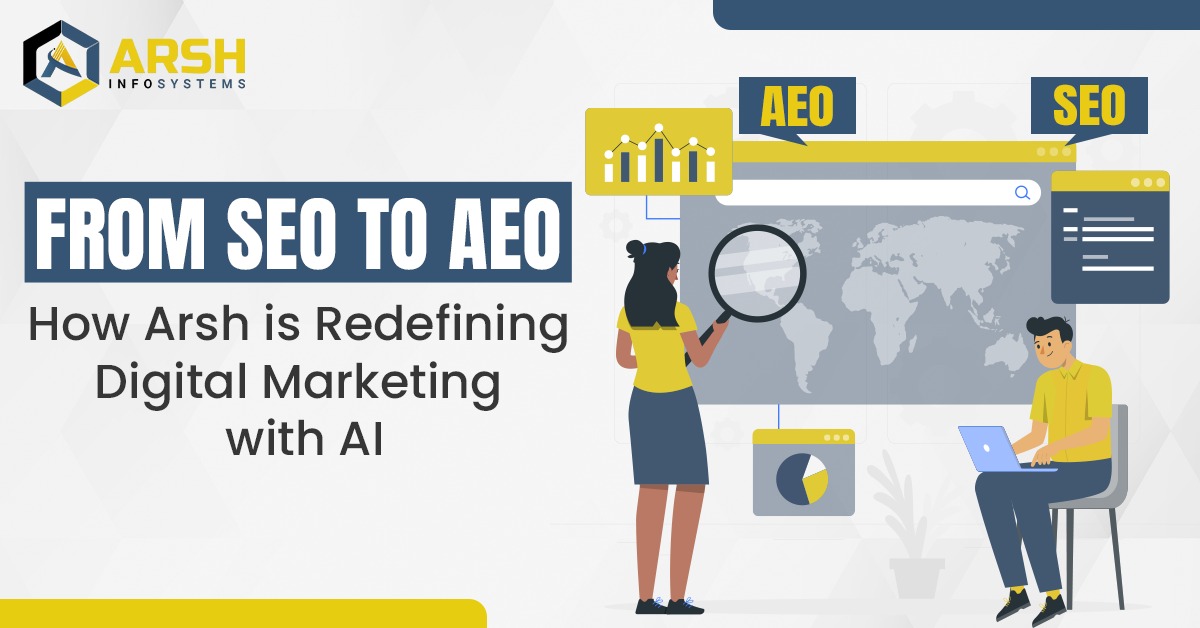
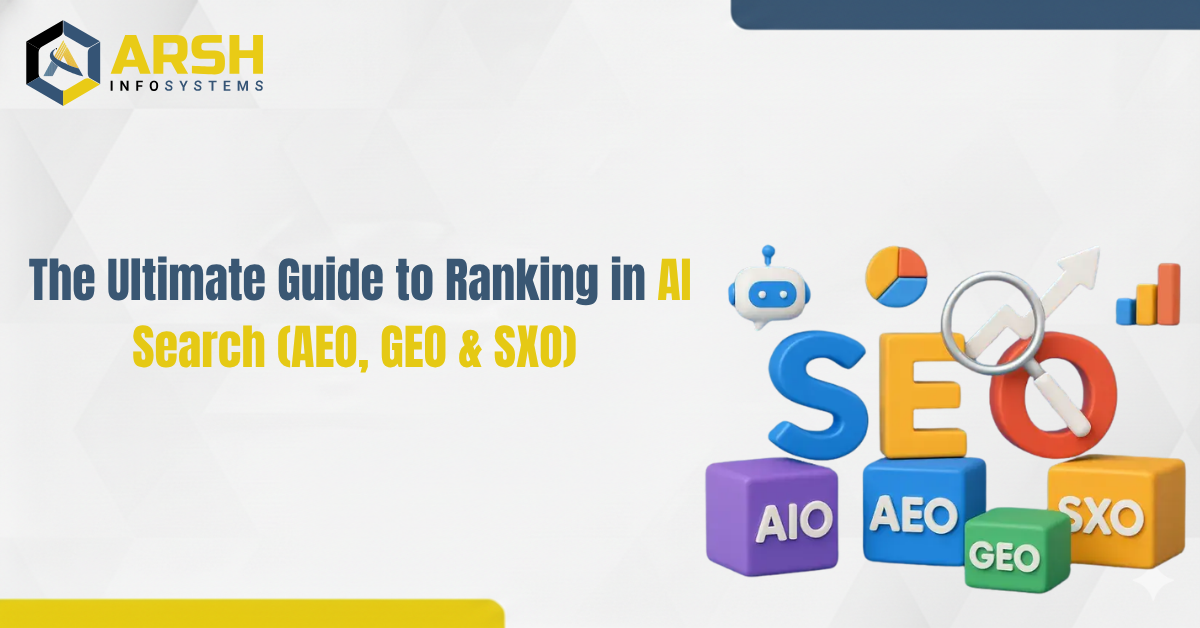
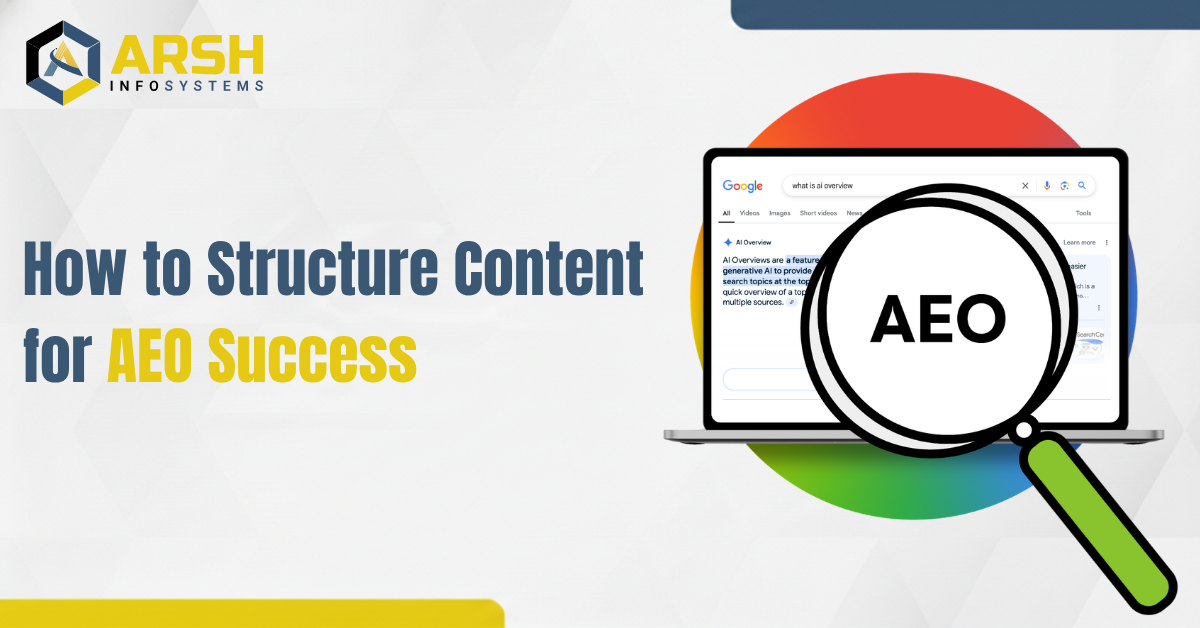
Answer Engine Optimization (AEO) is where this is. AEO, in contrast to conventional SEO, focuses on well-structured, concise, and clear answers rather than lengthy and unstructured content. It is about ensuring that your content is easily comprehended, interpreted and provided to the users by AI systems in real time.
In order to be able to really use these ideas, practice is as important as theory. The gap between the knowledge of AEO and the successful application of it can be bridged by learning through real-world strategies, as are adopted by Arsh Infosystems.
You will also learn in this guide how to get your content organized in order to achieve AEO success and have it picked by AI tools, featured snippets, and better in voice and conversational search results.
Answer Engine Optimization (AEO) is the art of formatting your material in such a way that it directly answers user queries in a simple, succinct and extractable format. The idea is to ensure that your content is easy to understand, pulled and displayed by search engines and AI platforms as instant answers.
In contrast to conventional SEO that aims to rank web pages, AEO is about being chosen as the answer. It places more importance on the effectiveness of your content serving user intent as opposed to the number of keywords it contains.
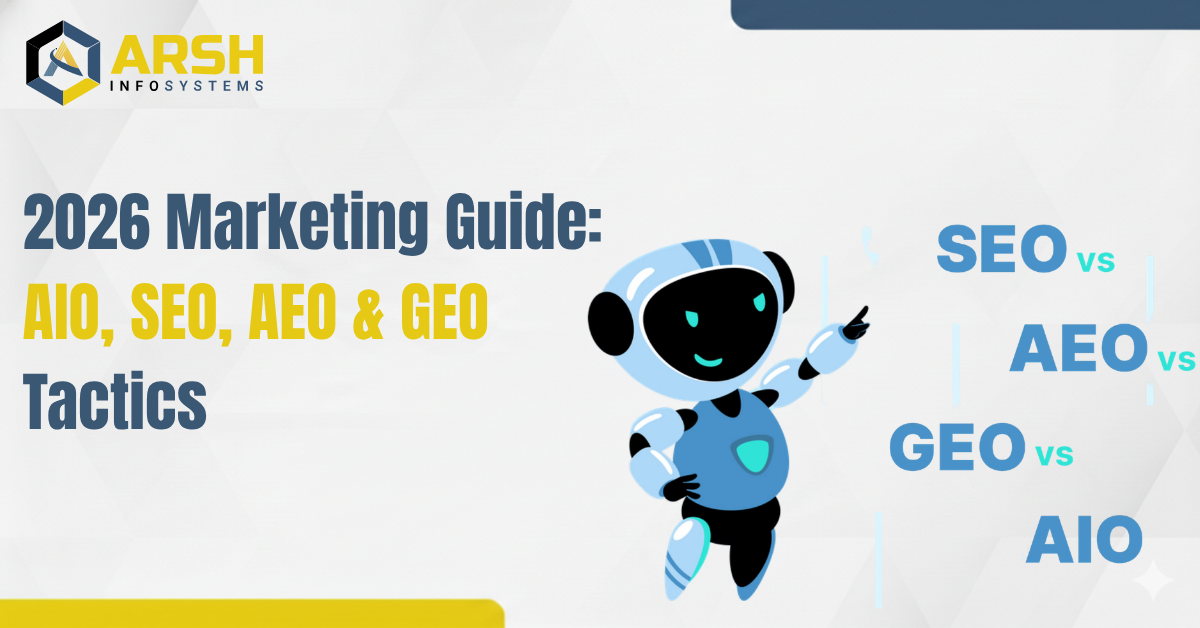
The differences between AEO and conventional SEO
Google search, ChatGPT, and voice assistants are today focused on answer-first, well-structured content. Your content must be straightforward and simple to interpret and in the case, your content directly answers the query of a user, it has a much higher possibility of being featured.
Why AEO Matters
With the changing nature of search, users are not going through numerous pages anymore, they want quick and correct answers. AEO does not only ensure your content is visible, but also selected, highlighted and trusted on AI-driven platforms.
In simple terms:
SEO makes you appear high.
AEO can assist you to be selected.
The reason why Traditional Content is unsuccessful in AI search
The majority of blogging now is done with answers in mind, but not key words. Such a strategy worked in the case of traditional SEO, and it does not perform well in artificial intelligence-based search platforms.
AI platforms do not read in the same way that humans do. They scan, extract and rank organized information. Unless your content is clear, direct and well structured, then it is much more likely to be ignored.
Common Issues
Key Insight:
AI systems do not read, they retrieve and extract. Unless your content is arranged appropriately it will not be chosen.
Your content must have a clear, answer-first structure in order to be effective in AI search. The following is a practical structure that you can use:
The name of your title must be directly related to one of the questions that the users are asking.
Examples:
This matches your content with the actual search intent, boosting visibility.
Immediately you can answer your H1 in a clear and concise manner (2-3 sentences).
The section is very important because:
Example:
AEO refers to organizing content in a way that offers direct and easy to understand responses to user queries and therefore easier to be extracted and presented by search engines and AI platforms.
Following the direct response, elaborate with pertinent information:
Make paragraphs brief, concise and understandable.
Divide your material into rational parts:
This improves:
AI systems like structured formats such as:
These formats simplify your content to extract and present in answers.
Enhance your text with real life examples like:
This enhances E-E-A-T (Experience, Expertise, Authority, Trust) and develops credibility.
Add structured data to your content:
This enhances your likelihood of:
In order to be effective in the Answer Engine Optimization (AEO), your content must be purposeful, well organized, and conveniently retrieved by the AI systems. A workflow that can be followed is as follows:
Step 1: Know User Intent
Begin by understanding the real queries and the intent of those queries made by the users.
This is to align your content with actual user needs, and not only keywords.
Step 2: Have an Interrogative Title
Put your main keyword as a question.
Example:
This matches your content to user search and AI search to find answers.
step 3: Add a Direct Answer (Answer Block)
The next thing, directly following the title, is a concise answer (23 sentences), which is to the point.
⁻ This is vital to featured snippets, voice search, and AI answers.
Step 4: Supporting Context
As soon as the answer is obvious, elaborate on it:
Use paragraphs that are not too long to read.
Step 5: Organize using Headings
Divide your content into coherent parts:
Artificial intelligence (AI) interpretation and processing.
Step 6: Take Lists and Visual Organization
Enhance the ease of consuming and extracting your content with:
Formatting assists the AI systems to extract important information fast.
Step 7: Add FAQ Section.
Add some of the commonly asked questions on your topic.
Benefits:
FAQs also enable you to have even more complete and user-oriented content.
In order to see the effect of the Answer Engine Optimization (AEO), we can take a closer look at how content can perform both when it is not properly structured and when it is optimized in search terms to be recognized by AI.
Poorly Structured Content
Result: Hard to comprehend by users and AI systems. There are reduced chances of extracting, featuring, or ranking the content.
AEO-Optimized Content
Result: Increased ranking in search results, increased opportunities to get featured snippets and AI answers, and enhanced user interaction.
In order to make your content effective with AEO, make it clear, easy to understand, and simple.
The point: The easier your content is to read and the better it answers the question, the higher the probability that it will be selected by AI and appear in search results.
Common Mistakes to Avoid
These are some of the pitfalls that should be avoided when maximizing content to AEO:
Final Thoughts
With the continued evolution of search, ranking on search engines is no longer a success, but being selected as the solution. Answer Engine Optimization (AEO) is all about being clear, quick to structure, and intentional in what you want the AI to read and display, simplifying your content.
Properly and well-structured content, with answer-first content, not only enhances the search results but also enhances your likelihood of being included in featured snippets, AI-generated answers, and voice search. The trend should be to create content that explicitly answers user queries in a simple and structured manner, rather than writing to the algorithms alone.
Copyright © 2026 All Rights Reserved By Arsh Infosystems.
Reviews On 
Years experience
Satisfied clients