Komal Saim Feb 04, 2026


Komal Saim Feb 04, 2026
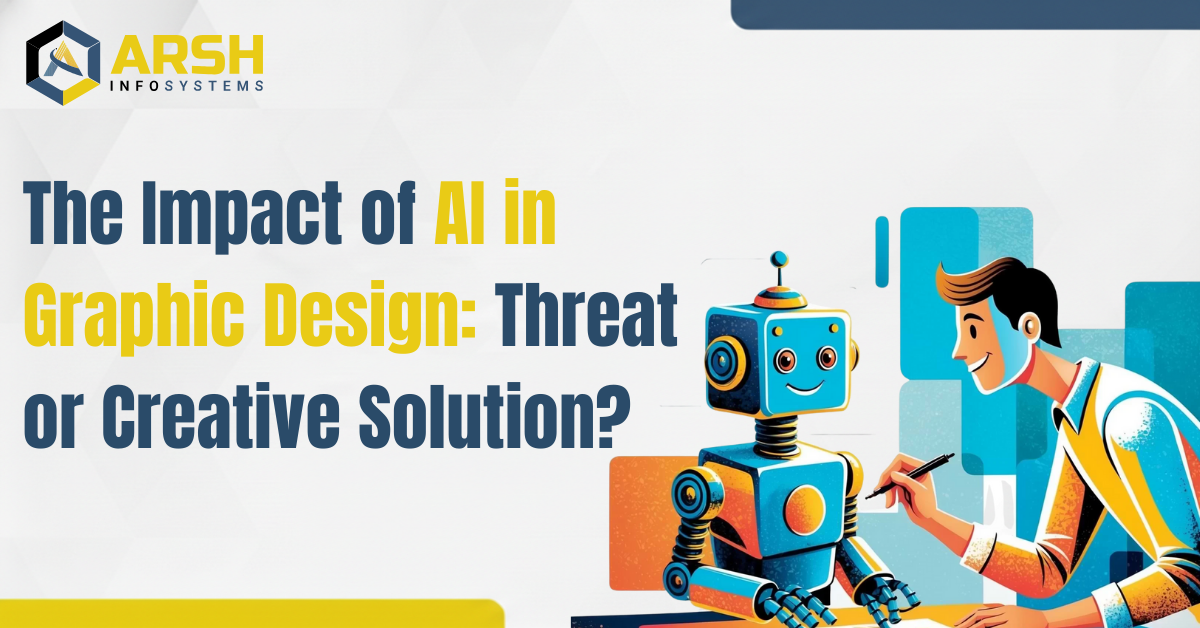
Design software has continued to add automation over the past ten years, starting with smart alignment tools, content-aware fills and object recognition. All of the innovations have promised speed and efficiency, but none of them has disrupted the creative industry as much as the present wave of generative AI. As opposed to the previous tools that helped with execution, today's AI questions something much more essential: the role of the designer is that of a thinker, rather than a producer
This discussion has already taken a flight beyond the faster-but-not-better part of the discussion to larger and more uncomfortable topics. Is it possible to produce original ideas by AI? Is it able to undertake complete design projects? And, should it be able to, what will it mean to the future of graphic design as an art? This change could not have been timed at a worse time for brands. The pressure on marketing budgets grows, the turnaround times become reduced, and viewers require really personalised images on the websites, social media, advertisements and others.
Generative AI claims to be the solution to the three problems: speed, scale, and personalisation. But the concerns are real. An over-reliance on AI will risk visual homogeneity, brand watering down, and a grey zone in data use and copyright. Accidental design is easily transformed into decoration, whereas unthoughtful automation can undermine narration.
In our case at Arsh Infosystems, AI is not intended to substitute designers, but a very potent addition to the design toolkit. Technology must not dominate strategy in graphic design. Human intuition, brand awareness, cultural background and emotional intelligence cannot be replaced, and it is particularly when creating images that resonate, convince and last longer.
The anxiety about AI in design is based mainly on three fundamental issues, i.e. ownership, originality and opportunity.
Ownership becomes unclear when AI systems are trained on existing artwork, raising valid questions about credit and copyright.
The originality is threatened by AI, which is able to produce various design options within seconds and this creates an unfair appearance of speed difference with the human process.
Opportunity is unsure when customers start doubting the necessity of retainers or the creative collaborations in the long-term.
Although these issues are factual, they are not novel. All of the significant changes occurring in design technology have brought with them the same apprehension before their use, turning them into an everyday instrument.Regulations are changing, and most platforms currently deploy rights-cleared datasets and creator compensation systems.
AI has yet to master the sphere of brand subtlety, cultural inclination, and emotional intelligence, in which human designers are dominating.
Strategy is still a human affair; it is the designers who determine why, when and how AI will be deployed.
Finally, AI is merely a tool, not a decision-maker and the designer is strictly in charge.
AI-based graphic design tools do not outperform creativity but augment it. Imagine them as draft generators that never tire and assist in the visualisation of half-formed ideas, experiment with unforeseen colour combinations and recalculate assets to fit any screen within a few seconds.
What is more important, AI liberates the designer to do what is really important in his/her life: to think conceptually, tell stories and discover brand meaning. In Indian agencies that provide digital marketing services, this change is already evident, as there is no more need to compromise quality due to tight timelines. The repetitive production tasks are managed by AI quietly so that the designers can remain focused on strategy and creative direction.
Reduced time to ideate, as many different visual directions are created on one prompt.
More intelligent design optimisation, based on forecasting data and attention trends.
Real-time localisation, simplifying multilingual and region-specific campaigns to be implemented across the various markets of India.
More importantly, none of it can work without human control. Any output requires judgment, refinement and intent. The speed of AI makes it faster, yet designers themselves were writing ideas, making decisions and approving the final work.
Practically, AI simply increases the canvas; however, it is human imagination that determines what to place on the canvas.
When the topic of AI and the future of graphic design is brought up, the same question always comes up at the very first instance: Will AI displace designers?
The truth behind it is more delicate. AI will not face out designers, but designers familiar with how to approach AI will become more and more dominant, to displace those who are not. As historical instruments transformed workflows, AI is reinventing effective, flexible and valuable in a creative position.
What is more interesting is not what is being washed away, but what comes up. Hybrid duties are already emerging, leading to rapid changes in the kind of strategist, AI workflow designer, and model ethicist professionals who would be both technologically fluent and traditionally design-thinking, visually impulsive, and brand insightful.
Read Also: AI for SEO in 2026
In the future, design teams can use off-the-record, brand-trained AI models that can generate images that can remain on-brand and avoid intellectual property theft. Here, agencies providing digital marketing services in India are especially well placed, having responsibly trained AI to manage the scaling of campaigns along channels and languages, without being culturally irrelevant or lacking in emotional context.
The graphic design does not have a future that leads to extinction. It is directed to evolution, in which the creativity is increased, the roles are broadened, and the judgment of man stands at the centre of the meaningful design.
AI is no longer a far-off thing in graphics design; it is already integrated into the routine creative processes. However, its true effect is not in displacing designers but transforming the way design is conceived, performed and presented. Technology is most effective in aiding creativity and not in crowding creativity out.
In the case of brands, it is not a matter of either human or machine. It is regarding the level of thoughtfulness in the process of AI integration. Speed and scale are important, although they can do little without clarity, emotion, and purpose. These are what can be brought to the table by human designers.
Here at Arsh Infosystems, we are of the view that the future of graphic design is in teams that are both innovative and deliberate. AI assists in increasing the speed and exploring further, yet human intuition holds that all the visuals will be genuine, tactical and close to the audience they are made for.
Copyright © 2026 All Rights Reserved By Arsh Infosystems.
Reviews On 
Years experience
Satisfied clients