Komal Saim Nov 03, 2025


Komal Saim Nov 03, 2025
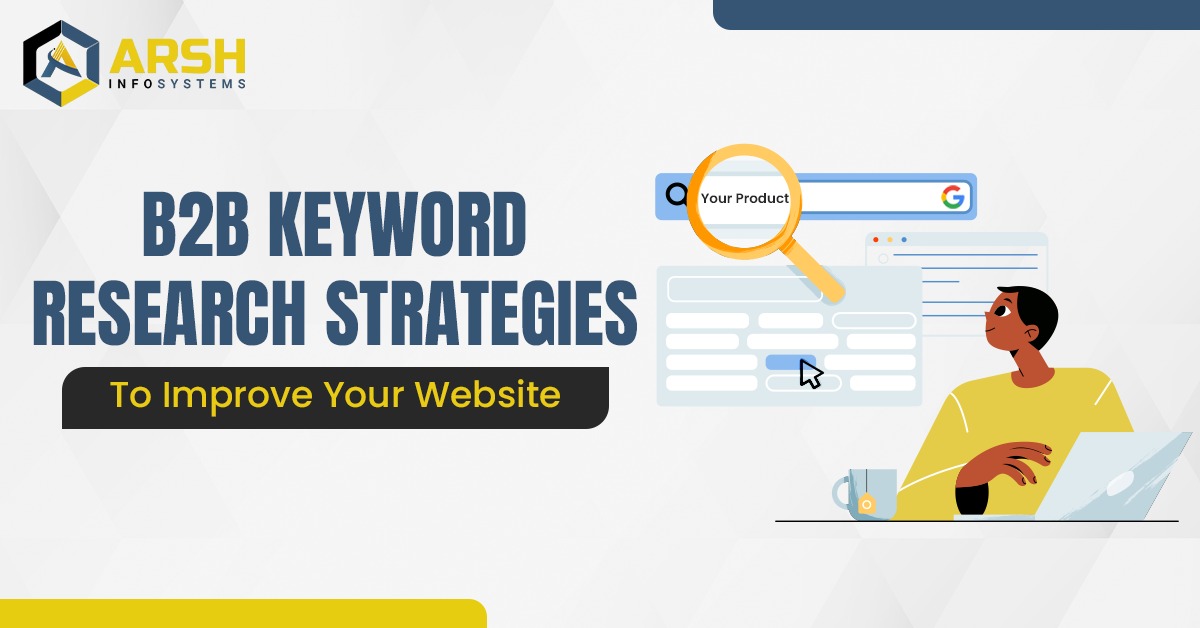
In the modern digital world that is constantly evolving at a fast pace, B2B SEO is not about stuffing your site with keywords anymore, but it is about using the right keywords that actually make your business grow. And that is precisely where Arsh Infosystems comes in to promote brands. Using smarter keyword tactics and an in-depth comprehension of search behaviour, your website can be ranked out of the "hardly noticed" category to a high ranking on the search engine results page (SERP).
The reality is that, in case you are targeting the wrong keywords, then your site will be an empty showroom with no traffic, no leads, no conversions. Worse still, by attacking irrelevant words, you may end up attracting visitors who are not interested at all in your solutions. Intentional traffic is of no use.
However, when your keyword strategy is glued to your buyer intent, search trends, and industry demand, all this will be different. Arsh Infosystems will also place your website in the right place at the right time, as the decision-makers are searching, directly where they are required to be, at the time they need your services.
It is high time to reconsider, update, and replenish your B2B keyword strategy. We will take a look at how an elegant strategy can increase your presence, generate qualified leads and make your own business experience greater levels of conversions, regardless of the size or the industry.
An effective B2B keyword is more than a tool that will allow you to have a presence on Google; it will put you right in front of the appropriate decision-makers. SEO increases the visibility of your site by matching what your visitors are already searching for with the content on your site. When you apply the keywords that are relevant to their purpose, Google will consider your information as pertinent and rank it better.
As an illustration, when you are a manufacturer of metal parts and you aim at the designers of electric vehicles, their searches will vary depending on their position in the buying process. They may seek issues, remedies or fresh opportunities. With such an intention, you get the right traffic that is more likely to be converted by knowing the right keywords.
Awareness Stage: The buyer is at the start of the journey and is only becoming aware of the fact that not everything is going on as it should. Indicatively, they may be interested in knowing whether their stamped component is operating optimally or not. This is when they start searching the general, informational terms in order to get a better idea of the problem.
Examples of keywords include: electric motor efficiency.
Consideration Stage: When the buyer is aware of the problem, they begin to find out ways of solving it. They explore further into materials, technology or processes that may assist in correcting the problem. They attempt to know how various approaches work and this makes their search narrower.
Example of Keyword: design of AC electric motors.
Decision Stage: The buyer at this point has already determined the most desirable solution, say, improvement of component efficiency through powder metallurgy. Having this understanding, they are willing to act. Their searches change to the question of who, where they want to find the right manufacturer or expert to collaborate with.
Example of a keyword: powder metallurgy manufacturers.
The quality of your keywords is huge when you are developing a good B2B SEO campaign, particularly with small and medium businesses. And the selection of the appropriate ones is reduced to three essential factors.
1. Searcher intent
2. Keyword difficulty
3. Monthly search volume
The best B2B keywords are the ones with strong intent, low competition, and enough search volume to make an impact.

Searcher intent is the most critical search criterion in B2B SEO. In simple words, it demonstrates the relevancy of a keyword to your business, products or the problems your customers would like to resolve. Improperly using keywords may lead to the presence of the wrong type of visitor, which will not translate to leads or sales.
Searching for search engine keywords that are not relevant or that are broad is harmful to the performance of your website:
The application of irrelevant keywords or overloading of content with relevant yet irrelevant keywords can also be viewed as black hat SEO. Google is able to punish your site on this; hence, it is best to consider relevancy.
Why relevant Keywords Work
By using the right keywords that will be relevant to what your audience is seeking, you get to attract good quality traffic people who are more likely to get interested, make inquiries or make a purchase. The appropriate keywords ensure your content ranks higher, becomes more engaging and leads.
High-quality traffic can be attracted by using the keywords that are relevant to the needs of your audience. Such visitors have higher chances of engaging, seeking information or purchasing the product, which transforms the organic traffic into actual business prospects.
Example 1: Reaching the Right Audience.
Example 2: Appealing to the Right Stage of Buyer Journey.
The difficulty of a keyword indicates the difficulty of ranking a particular term. Most of the tools, such as SEMrush, have difficulty ranging between 0 (easy) and 100 (very hard). Trying to compete in highly competitive keywords can be expensive and time-intensive for small and medium B2B businesses.
Rather, consider low-difficulty keywords that are niche-specific or product-specific to your services or products. These are mostly location-based, long-tail or directly connected with your business, providing you with more possibilities to rank more quickly. The short-term goal of competing with global giants is hardly effective.
Imagine that you are a precision machining service and you are interested in attracting aerospace customers with the help of your blog.
By targeting low-difficulty high-intent keywords, small businesses can compete, reach the right audience, and increase their visibility within the search engines.
The fact that one of the keywords is not competitive does not mean it will be helpful to your business, so long as no one is typing it. There is no need to be ranked number 1 on a keyword that has zero interest. That is where monthly search volume comes in, it displays the number of people actively searching a term every month.
However, a high volume of search is not sufficient. To use this as an example, the CNC machining has 110,000 searches every month, yet when your small or niche B2B website cannot even realistically rank that high, you cannot get those searches.
Low-volume keywords can also be very valuable in the case of niche industries. Better to be ranked well in a highly relevant keyword that brings 20 qualified visitors per month than to be involved in a generic keyword that ends up bringing 2000 irrelevant visitors. In B2B SEO, quality is better than quantity.
The following gives a rough overview of what is expected on a monthly search volume, as regards page type:
It is important to remember that the priority should be given first to search intent and keyword difficulty. Your expectations should be in line with the monthly search; however, the results are only achieved based on relevance and competitiveness.
The correct choice of B2B keywords is not solely based on guesses; it involves the integration of keyword research tools and buyer persona knowledge to identify the keywords that actually will produce the outcome. With both in mind, you will be able to find high-intent and low competition keywords that will bring qualified traffic and also boost your positions.
Keyword Research Tools
To assist you in finding good B2B keywords, there are a number of tools that can be used. Although the Keyword Planner of Google is a popular one, other free and paid solutions are more detailed:
Also, your Google Search Console will indicate all of the keywords for which your site is already in the top positions. Evaluation of this data assists in revealing new opportunities and perfecting your strategy.
Remember, the metrics involving keywords of these tools are not accurate numbers, but approximations. The search information at Google is highly confidential, and this is one of the reasons why search results at Google are precise and relevant.
The usefulness of a keyword is based on its ability to match the needs of your audience. It is very important to know your buyers before completing your keyword strategy.
Here's how to approach it:
By adding these findings to your keyword research, you are guaranteed to be appealing to problem-specific, industry-specific, and product-specific keywords that appeal to actual purchasers.
Using a combination of keyword tool data and comprehensive buyer insights, you will be able to produce a B2B keyword strategy that will not only increase the search rankings but also bring the right visitors on board who stand a better chance of converting.
To be a great keyword is not a phrase but a tool that brings the right people to your site. To do well, a keyword must be the most compatible with what you are producing and selling, the competition must be low to medium, and the audience must be the one that is likely to convert. When your keywords are not hitting you, your site will rank, but you will not get meaningful leads or sales.
Our SEO checklist enables you to determine the location and use of keywords on your site and increase visibility, interaction and conversion. When you place your keywords in the right places, they begin working harder and qualify visitors and increase your overall performance in B2B in terms of SEO.
If you want to turn your website into a lead-generating machine. Arsh Infosystems can help. Our free e-book walks you through building a strong SEO foundation and fine-tuning your B2B keyword strategy. By following proven SEO practices, you can attract the right audience, boost search rankings, and increase conversions.
Today, contact us and find the difference that a focused keyword strategy will have in your business.
B2B keyword research plays a central role in ensuring the appropriate traffic, better rankings, and qualified leads. With the help of matching tools and buyer insights, your site will attract the right people and increase the conversion rates with the help of high-intent, low-competition and relevant keywords. Arsh Infosystems assists in developing a specific plan to convert visitors into actual business prospects.
Copyright © 2026 All Rights Reserved By Arsh Infosystems.
Reviews On 
Years experience
Satisfied clients