Komal Saim April 21, 2026


Komal Saim April 21, 2026
Search has not died- but the manner in which people find information has greatly increased.
There is no such thing as traditional search results nowadays. In addition to the old blue links, users can now find AI-driven solutions, summaries, and interactive panels, which in many cases, one can get information immediately even without clicking a button.
This change is transforming the visibility of the same.
Traditional SEO is not enough anymore to ensure that your brand will be visible. It is no longer a contest based on the rankings but being present in a variety of discovery layers, including responses based on AI.
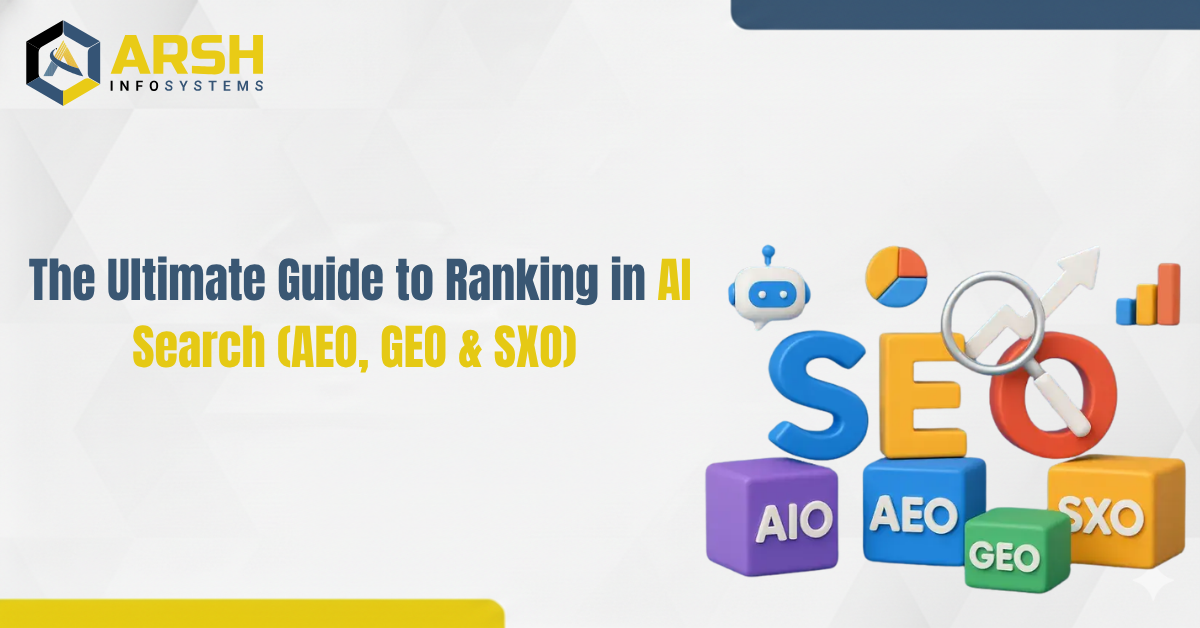
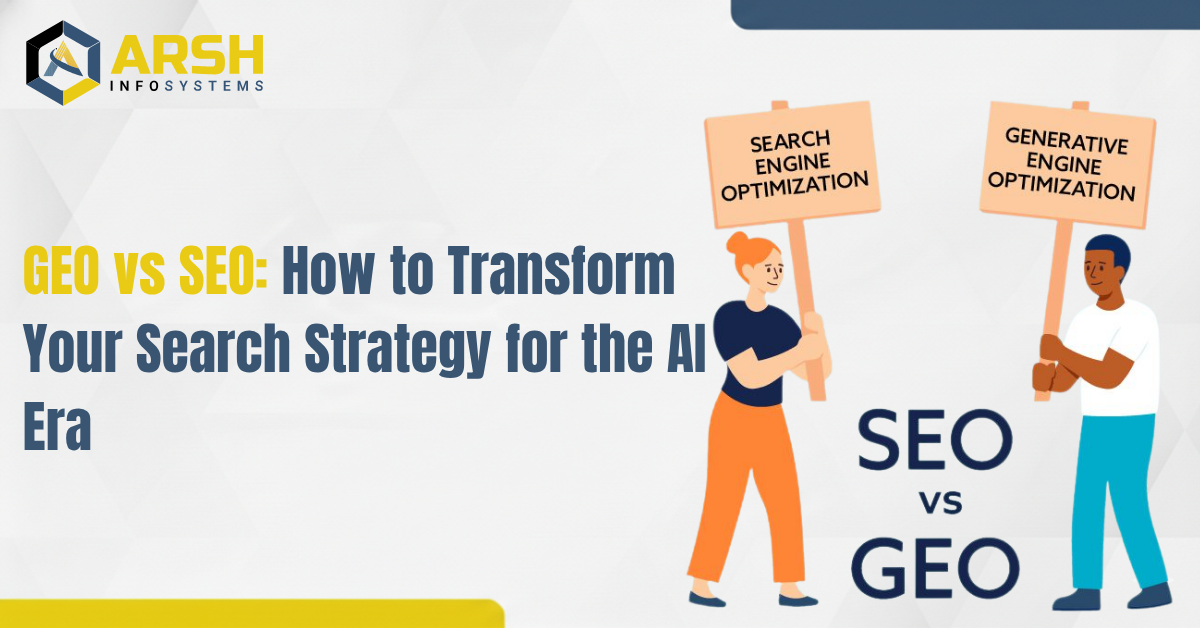
Then, the discussion between GEO (Generative Engine Optimization) and SEO (Search Engine Optimization) comes into play.
In this article we will deconstruct what is evolving, what is still worth keeping and how companies can evolve their strategies to ensure they are visible in both search engines and AI-based platforms.
To progressive digital organizations such as Arsh Infosystems, this change is an opportunity - not only to optimize towards rankings, but to create content that can be discovered, used, and valued both within a traditional and an AI-driven ecosystem.
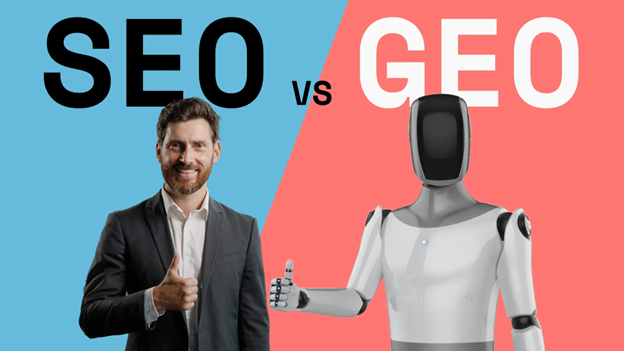
On a bigger scale, the purpose of both SEO and GEO is identical, i.e., to assist the appropriate audience in finding reliable information and, hopefully, your brand. Where and how that visibility occurs is the difference.
| Area | SEO (Search Engine Optimization) | GEO (Generative Engine Optimization) |
|---|---|---|
| Primary Surface | Google & Bing SERPs (blue links, featured snippets, rich results) | AI-driven platforms (ChatGPT, Gemini, Perplexity, AI overviews, conversational interfaces) |
| Main Outcome | Website clicks through rankings and search listings | Brand mentions, citations, and recommendations within AI-generated responses |
| Visibility Metrics | Rankings, impressions, CTR, organic traffic | Citation frequency, answer inclusion rate, AI visibility, brand mentions |
| Optimization Focus | Keywords, on-page SEO, technical structure, backlinks | Entity recognition, authoritative sources, structured data, machine-readable content |
| Ranking Logic | Search algorithms based on relevance, backlinks, and content quality | AI models using training data, retrieval systems, authority signals, and safety layers |
| Time Horizon | Long-term (months to build, relatively stable over time) | Dynamic (frequent changes based on model updates and data sources) |
| Who Benefits Most | Websites with strong domain authority and solid SEO foundations | Brands with strong digital presence across multiple platforms (owned, earned, and referenced sources) |
Zero- click searches are not novel. The featured snippets have already minimized the number of clicks that users have to make in order to access websites.
This trend has however been further intensified with the emergence of AI Overviews and conversational search.
These days, the users are frequently provided with all the answers on the search page, without having to go to a webpage at all.
This does not imply that visibility is not significant. It is nothing but the definition of success is changing.
It’s no longer just about getting the click, it's about being mentioned, cited, and trusted within the answer itself.
Modern AI systems don’t rely solely on real-time web content.
Their functioning is based on a mix of:
This implies that your content can shape AI-generated responses well after being published.
It also brings out a significant change:
The value of your historical information and third-party references might have an everlasting value, not only in traditional search rankings.
Search systems based on AI prefer to rank the content of high-authority and reputable sources.
This includes:
This is more so when dealing with sensitive or high-impact subjects (commonly known as YMYL Your Money or Your Life).
Consequently, the need to establish credibility now extends beyond an SEO consideration and is critical to AI visibility, as well.
Although AI is mighty, it is not all-powerful.
Risks still exist of:
This goes beyond traffic concerns; it can directly impact brand trust, reputation and even compliance.
Due to this reason, businesses should not be bothered with just being visible, but also precise, consistent and controlled in their messages at all their digital touchpoints.
The transition away from the old SEO towards GEO does not demand a clean sheet. Rather, it is a question of diversifying your current strategy in order to remain visible both in search engines and AI-based platforms.
The following is a step-by-step upgrade path:
List popular sites with documents (blogs, directories, review sites, etc.).
This is now your GEO visibility map - where you must be.
AI systems are highly dependent on explicit, stable entity recognition.
Normalise your brand name, product names and other important details over all platforms.
Make sure that there is uniformity in location, founder details and company descriptions.
Update important profiles such as:
Work with structured data such as:
This assists AI systems to have a clear understanding of your brand and how it relates.
The content must be human-readable, as well as intelligent to AI.
Add objective and precise sentences (e.g., statistics, facts)
Write short and specific sentences that can be easily identified.
Include structured components such as:
Find supporting materials and sources to establish credibility and authority to support your claims.
AI systems highly favor third party, trusted sources.
Concentrate on the platforms that were used in your previous audit - in case AI believes them, you are highly needed there.
Stop thinking in terms of keywords and start with questions as part of content strategy.
Study what users are requesting AI tools to do.
Use insights from:
Build content around:
This increases the chances of your content being referenced in AI-generated answers.
While evolving, don’t ignore your technical foundation.
The AI systems are also based on structured, available web data - hence your SEO basics are still required.
GEO is the answer to where machines respond to where people search, which is the case with SEO.
Information discovery by users is changing. Engine engines are no longer a gateway - AI-driven platforms are emerging as a parallel layer with users receiving direct answers, recommendations, and summaries.
This does not indicate that SEO is going to become obsolete.
SEO is the basis.
It keeps on pushing visibility, traffic, and authority.
Generative engines are introducing a third dimension of discovery - one in which responses generated by AI are more likely to affect the decision-making process than those generated by traditional search engines.
It projects it on the AI-based terrain, providing new touchpoints, new visibility measures, and new challenges.
In the case of founders, CMOs, and growth leaders, the emphasis must change with the technology.
The dynamics of visibility is shifting:
The key to adapting effectively is to comprehend this shift.
Not always follow your Google rankings.
Evaluate:
The way your brand will be reflected in the answers provided by AI.
Being cited or referenced.
The positioning of competitors.
This will provide you with a realistic perspective on your visibility beyond the conventional search.
In order to remain pertinent in SEO as well as GEO:
The idea is to make it simple to understand by the machine and to be referenced to.
The way businesses handle ads, SEO, and social media, AI visibility now requires management as well.
AI is determining perception and that renders governance necessary.
Search is not going away, it is changing to be more broad, dynamic and AI-driven. A simple query to click is slowly turning into a multifaceted experience where users tend to receive answers immediately, without the need to go to a web page. In this new climate, visibility is not determined by rankings alone, but by presence, credibility, and the representation of your brand in AI-generated responses.
Here the equilibrium between SEO and GEO is vital. SEO remains the cornerstone - it establishes your authority, traffic, and makes your content discoverable. But GEO takes that base to the next level as AI systems derive, summarize, and provide information to users.
Copyright © 2026 All Rights Reserved By Arsh Infosystems.
Reviews On 
Years experience
Satisfied clients