Komal Saim Jan 05, 2026


Komal Saim Jan 05, 2026
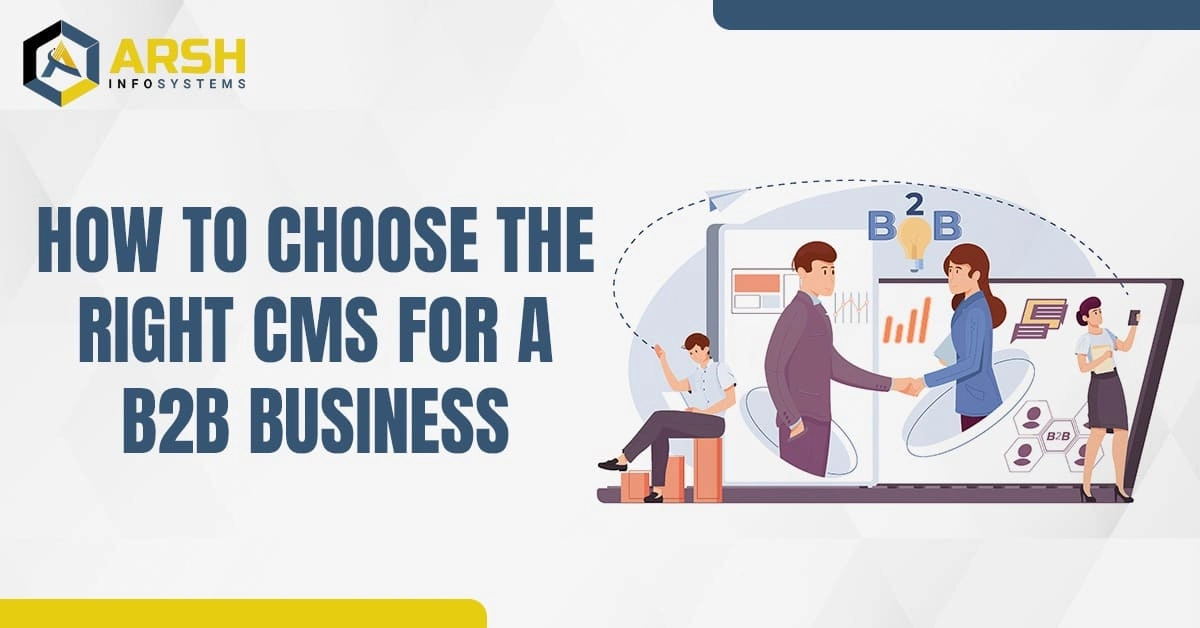
In the current digital-first B2B world, a website is no longer merely an online brochure; it is a potent business tool that will promote brand recognition, lead generation and consumer confidence. Whether it involves attracting qualified prospects and assisting sales teams in presenting your content, whether it happens in one or more digital channel environments, your Content Management System (CMS) is crucial to the degree to which your business really works online. The properly organised CMS allows the teams to cope with the content organisation and control, to sustain the stability, and to address the shifts in the market and adjust to the changes promptly.
Nevertheless, the selection of the appropriate CMS for a business to B2B is not so straightforward. Compared to B2C websites, B2B sites need to accommodate elaborate content designs, procurement duration, numerous stakeholders, along with assimilations with enterprise tools, all without affecting great levels of safety and scalability. At Arsh Infosystems, we assist the B2B organisations in choosing and deploying CMS solutions that can meet their business objectives at present and in the future. This guide will ensure you know what you should look at in a CMS as well as how to select a platform that will give you a robust digital base.
In the case of B2B organisations, content is not simply information but a business strategy that leads to business development. In creating awareness among the potential consumers of complex products and services, establishing trust and developing leads in lengthy purchase cycles, content is a critical element in taking the potential clients through the entire process of the sales funnel. An effective CMS can make sure that this content is not only developed efficiently but also distributed effectively and regularly in various channels.
A properly selected CMS would allow B2B companies to:
Store and administer extensive amounts of content across the board:
Whether it is product documentation, case studies, whitepapers or blog posts, a strong CMS helps teams arrange, update and distribute content smoothly and without hiccups.
Present content on numerous digital touchpoints: Contemporary B2B buyers engage with your brand on sites, mobile applications, email messages, and even portals with other partner companies. A robust CMS makes the content the same, customised, and available at any location where it is needed.
Improve the interactions between marketing, sales and technical teams: The teams are able to collaborate effectively without any conflicts and mistakes because of features such as role-based permissions, workflow approvals, and content versioning.
Scale operations as your business grows: The CMS can scale to meet the needs of a larger audience as the size of your product portfolio increases and more complex operations are introduced without affecting its performance.
Devoid of the appropriate CMS, B2B entities tend to experience a delay in getting important content posted, have fragmented experiences on different channels and are unable to create a smooth experience for their prospects and clients. Selecting a CMS that can support the goals of the business and technical specifications is, thus, crucial to creating a competitive and future-focused online presence.
The content teams in B2B usually involve marketers, writers, product managers and subject-matter experts, most of whom might not be technically oriented. An effective CMS must have a simple-to-use interface that enables users to compose, make changes and publish their content without necessarily having to engage the developers. Included with the options are the use of drag-and-drop editors, visual previews, inline editing and content scheduling, among other features that can help teams to stay on track with the content pipeline. Also, version control and approval processes help in ensuring that content is reviewed and approved before going live and reduce errors and poor content in all channels.
B2B customers use web, mobile applications, email, social media and partner portals as some of the touchpoints with the brand. The multi-channel delivery supported by CMS will make sure that your content is delivered wherever the audience will be. Particularly useful are headless or API-first CMS systems, which separate content and presentation, and thus allow the same content to be used in other channels and formats. This strategy expands efficiency and also provides a stable message and branding at all touchpoints.
Global B2B firms usually have to interact with markets in various geographical locations and languages. A strong CMS must be able to assistwithe multilinguacontentts, translation processes, as well as the localisation capabilities, whereby you can customise the content to suit any market. This involves localised landing pages, description of products in the local language, and localised marketing messages. The localisation process in CMS is simplified, allowing businesses to be able to offer the relevant and culturally sensitive information without having to repeat the work and creating a versioning problem.
The process of B2B content creation is a team effort usually comprising marketing, product, design and technical personnel. A good CMS has access controls based on roles, where team members can only view and modify the parts that they are concerned with. The collaboration capabilities,s such as real-time commenting, workflow approvals, and content assignments, ts enable the team to perform their work smoothly without a sense of accountability. This minimises mistakes, prevents confidential information and ensures that content generation is streamlined even in massive organisations.
B2B CMS also needs to be focused on SEO optimisation and marketing automation. Elements such as flexible metadata, schema markup, URL management, and keyword analysis will allow your content to be ranked higher in the search engines, and this will push more traffic towards your business through organicmeans. Combining with email marketing, CRM and analytics software will make content capable of cultivating leads, monitoring engagement, and calculating the ROI successfully.
The larger your business, the larger your content needs and website traffic. An effective CMS must be scalable and capable of supporting additional users, increased content libraries, and increased traffic with reduced slowdown. Quick load times, high availability, and streamlinedback-endd infrastructure will be used to make sure that your site provides a comfortable user experience and keeps your potential clients interested.
B2B websites are prone to working with sensitive information and need to adhere to the regulations, including GDPR, CCPA or industry-related standards. An effective CMS has excellent security, such as user authentication, role-based access, data encryption and frequent upgrades. This minimises the chances of a breach and your business remains within the law.
A CMS does not operate independently. It should be integrated with other business tools that include:
It will have strong integration capabilities that will guarantee enhanced data flow, personalisation, and lead nurturing. The first consideration when selecting a CMS is how compatible it is with your current technology.
| Feature/Aspect | Traditional CMS | Headless CMS |
|---|---|---|
| Definition | Combines content management and front-end presentation in one system | Separates content management (backend) from presentation (frontend) |
| Flexibility | Limited flexibility; tied to predefined templates and front-end technologies | Highly flexible; developers can use any framework or technology for the front-end |
| Content Delivery | Primarily delivers content to the website | Can deliver content to multiple channels: web, mobile, apps, IoT, and more |
| Scalability | Suitable for small to medium websites; can become challenging for complex setups | Highly scalable; ideal for growing B2B businesses with expanding digital needs |
| Ease of Use | Easier for non-technical users; simpler setup and management | Requires developer support for front-end setup, but the backend is still user-friendly |
| Performance | May have slower performance if overloaded with plugins or heavy templates | Faster performance due to decoupled architecture and API-based delivery |
| Future-Proofing | Less adaptable to new technologies or channels | Future-proof; supports omnichannel delivery and modern digital experiences |
| Use Case | Small to medium-sized websites or simple digital needs | B2B businesses needing multi-channel content delivery, complex workflows, and integrations |
| Feature / Aspect | Open-Source CMS | Cloud-Hosted CMS |
|---|---|---|
| Flexibility & Customization | High – full control over design, features, and functionality | Moderate – limited to platform capabilities, but often highly configurable |
| Maintenance & Updates | Requires manual updates, maintenance, and patching | Managed by the provider with automatic updates and maintenance |
| Security | Responsibility of the in-house team: must implement security measures | Enhanced security managed by the provider, including monitoring and backups |
| Performance | Depends on your hosting and infrastructure | Optimised performance with managed infrastructure and scalability |
| Operational Overhead | Higher – needs dedicated technical resources | Lower – provider handles most technical management |
| Cost | Lower initial cost but potentially high maintenance costs | Subscription or SaaS-based; predictable long-term costs |
| Best For | Organisations with in-house development expertise and a need for full control | B2B companies looking for scalability, reduced IT burden, and faster deployment |
Maintenance, Security and Compliance
Security is very important to B2B websites, particularly when dealing with customer information or the integration of enterprise systems. Find a CMS with good authentication, compliance (including GDPR), and updates to security.
1. Define Your Business Goals
You must first define what you want to do with a CMS before you consider any of them. Is your commitment lead generation, sales facilitation, or becoming a thought leader? Or perhaps all of the above? Clear goals also make you decide what features are a must-have and also make certain that the CMS is part of your overall business plan. As an example, in case lead generation is on the priority list, you will require excellent connectivity with CRM and marketing automation platforms. In case content marketing is central, multi-channel delivery through sophisticated editorial workflows becomes crucial.
2. Learn Your Content Workflow
The effectiveness of a CMS is solely dependent on the workflow supported. Trace the process of content creation, review and publication in your organisation. Consider questions such as:
These workflows will guide you in selecting a CMS that allows collaboration, version control, and role-based permissions so that you can send all the content down the publication path without any bottlenecks.
3. Plan for Future Channels
The current reality of B2B interactions means that customers engage with companies on their websites, via mobile apps, in email newsletters, partner portals, and even Internet of Things devices. In selecting a CMS, consider the future and whether the platform is capable of accommodating future expansions or not. A CMS that uses an API, or is headless, such as the one described above, will enable you to provide content in any location and remain consistent. By investing in channel planning today, time, money and technical issues will be spared in the future.
4. Compare SEO and Performance Features
The visibility of the labour and performance of the search engines and the website will be vital in the attraction and retention of the prospects. Make sure that the CMS provides you with complete authority over the SEO factors of metadata, page URLs, structured data ( schema ), and mobile optimisation. Also, seek such features that contribute to better performance of the website, like high loading speed, support for caching, ability to respond to design, etc. An SEO-friendly and performance-friendly CMS will help provide your content to the right audience and deliver a buttery user experience.
5. Test Before You Commit
After shortlisting possible CMS platforms, do not choose one on the basis of demos or a list. Test or do proof-of-concept projects with actual content, workflows and members of the team. This field test will show the level of intuitiveness of the platform, its compatibility with your technology stack, and how easy the platform is to build into. Pre-testing minimises the chance of making an expensive error and it will help you select a CMS that really can fit your business.
Conclusion
The selection of the appropriate CMS to use in a B2B enterprise is not an easy task, as it can be highly effective in influencing your marketing effectiveness, sales quality and overall presence on the internet. A properly chosen CMS is a guarantee of the smooth content management, multi-delivery, high levels of security and scalability as well as collaboration between marketing, sales, and technical teams.
Assessing your business objectives, comprehending the workflow of content, strategising future channels, and experimenting with possible platforms allow choosing a CMS that should not only suit the present needs, but also facilitate further development.
Copyright © 2026 All Rights Reserved By Arsh Infosystems.
Reviews On 
Years experience
Satisfied clients