Komal Saim Feb 16, 2026


Komal Saim Feb 16, 2026
Search engines are confronted with this problem when your web site consists of several pages, which are almost exactly the same: Which page is going to be ranked? Unless you lead them in the right direction, your standings may be divided, your visibility may decline, and your search optimization process may fail to produce the complete effect.
Here, canonical tags will be important.
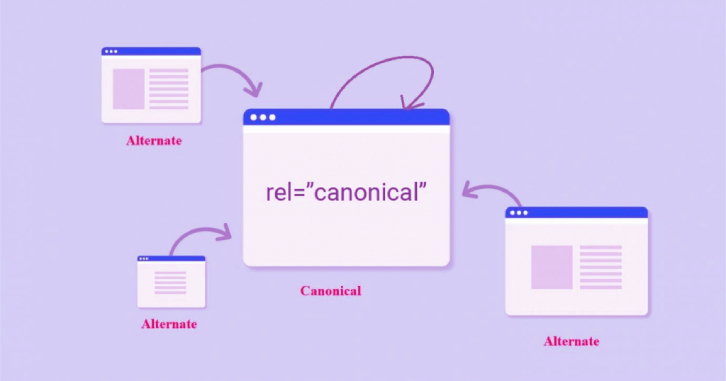
You do not allow the search engines to make guesses on which version of a page to use as the main one, but tell it clearly. Imagine it is a signboard so that it reads, "This is the official page, please rank this one. When properly applied, canonical tags will safeguard your SEO value, eliminate any confusion of similar content and maintain the organization of your site.
We shall know this in easy terms.
Most of the business owners imagine that the duplication of content can only occur when a person replicates content on another site. But the fact is that in the majority of cases of copying material, it simply happens accidentally.
As an example, your web site may generate several URLs due to:
All these variations can present the same or very similar content but search engines will treat them as different pages unless directed to do so.
Your SEO powers are split without the appropriate canonization. You can have a number of poor pages competing with each other instead of a single strong page.
Canonical tags are used to combine ranking signals including:
Canonical tags unify all the information into a single major version instead of distributing this value over several URLs. This enhances your ranking capability and general visibility.
This is a minor technical factor among those businesses that invest in SEO. That is why the correct canonical planning is always involved in professional SEO techniques not as a sort of an additional point, but as a core.
In Arsh Infosystems, there is a common occurrence where websites are losing ranking opportunities just because canonical tags were not included or set up in an incorrect manner. Their repair will make a lot of clients stabilize and improve their search performance, without even altering their content.
Suppose that you are producing industrial packaging machines. Your main service page is:
Every one of these URLs presents the identical core service information, identical specifications, identical inquiry form.
As a user, nothing is different.
These appear as different pages in terms of search engine.
Failing to specify a canonical URL, Google may:
In the case of B2B companies, this is dangerous as the pages providing the services are normally your lead generation main tools.
The Smart Move
canonical Relation to the URL of the original document.<|human|> <|human|>canonical A link to the original document URL.
And now search engines understand well:
The ranking of this is the main service page.
The link value, authority, and SEO signals of campaign URLs are all condensed into a single and strong page.
Why This Is Critical in B2B SEO
In B2B industries:
When your SEO strength is divided among more than one URL, you can become invisible on such high-intent keywords as:
Canonical-tagging makes your main service page stronger rather than it being competitors with its own duplicate pages.
Enhanced attribution of leads in analytics.
In the case of B2B brands, it is an increase in qualified traffic, enhanced flow of inquiries without having to spend more on ads.
Minor corrections make monumental changes in technical SEO. Canonical tags can be insignificant, but in B2B SEO strategy, they can be used to provide safety to the most valuable revenue making pages.
The reason why canonical tags are necessary is that the labels prevent duplication of content, which is silently undermining your SEO results.
Google must pick one that should rank when it finds out that there are several pages with similar or identical contents. Failure to give good direction may result in:
In simple terms, you do not create one powerful page but rather a number of weaker pages, which are in competition with the others.
Google has verified that it relies on dozens of signals (approximately 40+) in determining the canonical version of a page. This implies that canonical tags are very essential although they do not operate in seclusion.
The search engines also consider:
Canonical tags are a powerful direction, yet your general organization structure should endorse the same judgment.
Simple Example
Assume that your blog has published an article at:
The content is similar on the two URLs. By tagging with a canonical tag in the second version to /blog/seo-tips you are telling Google:
"This is the primary article. Please consolidate ranking signals here.
Consequently, the concentration of backlinks, authority and keyword relevance on a single clean URL is made.
The 2025 complexities in SEO have come in.
1. AI-generated Content and Semantic Duplicates
In a world where AI tools are commonplace, nowadays, a lot of websites will post content which is not copied but sounds very similar. Google highly sophisticated algorithms are able to identify such semantic duplicates - the content that deals with the same topic in virtually similar ways.
In case your site posts several pages written by AI, which address the same purpose, Google might consider them as duplicates - even when the language is a little bit different.
Canonical tags are now more significant than ever before in this setting. They however work effectively when accompanied by:
Discussed topics are clearly differentiated.
Canonicals are used to clarify structure - rankings are still made by content quality.
2. Syndicated Content Changes
The syndicated content (when the article is re- published on a partner-site) is another big update.
Many publishers had previously run canonical tags that were cross-domain in order to indicate the original source. Google however suggests otherwise.
Rather than only applying canonical tags on the domain level, Google recommends to use no index tags on the republished version to avoid being indexed.
The use of cross-domain canonicals is not always as expected. This is a major change to publishers. In case you syndicate content, ensure:
The Canonical tags make sense and work correctly
The following are golden rules of use of canonical tags in 2026:
Point to the main version - Canonical should be the desired page in search results.
Absolute URLs - URLs should always be of the form, https://www.example.com/page and not /page.
Add canonicals - You need to add canonical elements pointing to your main page even on your main page.
You do not canonicalise unique content - Canonicalise them to similar or duplicate pages.
No chains or loops - Do not reference Page A to Page B and Page B to Page C.
Consistent with sitemaps, internal links and redirects - ensure that sitemaps, internal links and redirects are all consistent with the canonical option.
Note hreflang contradictions Google cleared up that hreflang canonical annotations with hreflang, lang, or media are not taken into account. JavaScript Use good alternate hreflang tags on the international sites.
The wrong implementation will do more harm than good. Common errors include:
Example of a Costly Mistake
If:
/shoes/running has a canonical pointing to:
/shoes/old-running
The old page can supersede the new one in Google ranking and cause loss of traffic and loss of rank.
Even minor technical mistakes may have a serious effect.
Canonical tags can often be mistaken by people with the 301 redirects, yet they mean something different.
Canonical Tag
301 Redirect
Think of it this way:
Canonical tags should be used when there are duplicate URLs that require existence (e.g. tracking parameters or filtered view).
Apply 301 redirects in cases when an old page is superseded.
Also Check- what is 301 Status Code
Final Thoughts
Canonical tags might look as a minor technical aspect, but it is a large ingredient in safeguarding your SEO performance. They help to avoid the problem of duplicate content, unify the signals of the ranking and make sure that the search engines can refer to the appropriate page.
Small technical errors can even divide the power and decrease publicity in competitive markets particularly B2B. A well crafted canonical approach will ensure that your core pages are robust, enhance your crawling, and will favor growth in the long run.
Copyright © 2026 All Rights Reserved By Arsh Infosystems.